The E-field applied for the VCMA/Magnetoelectric coupling. (with the ramping function).
The E-fields can have multi-variants - (dwelling, pulser).
The electromagnetic filed.
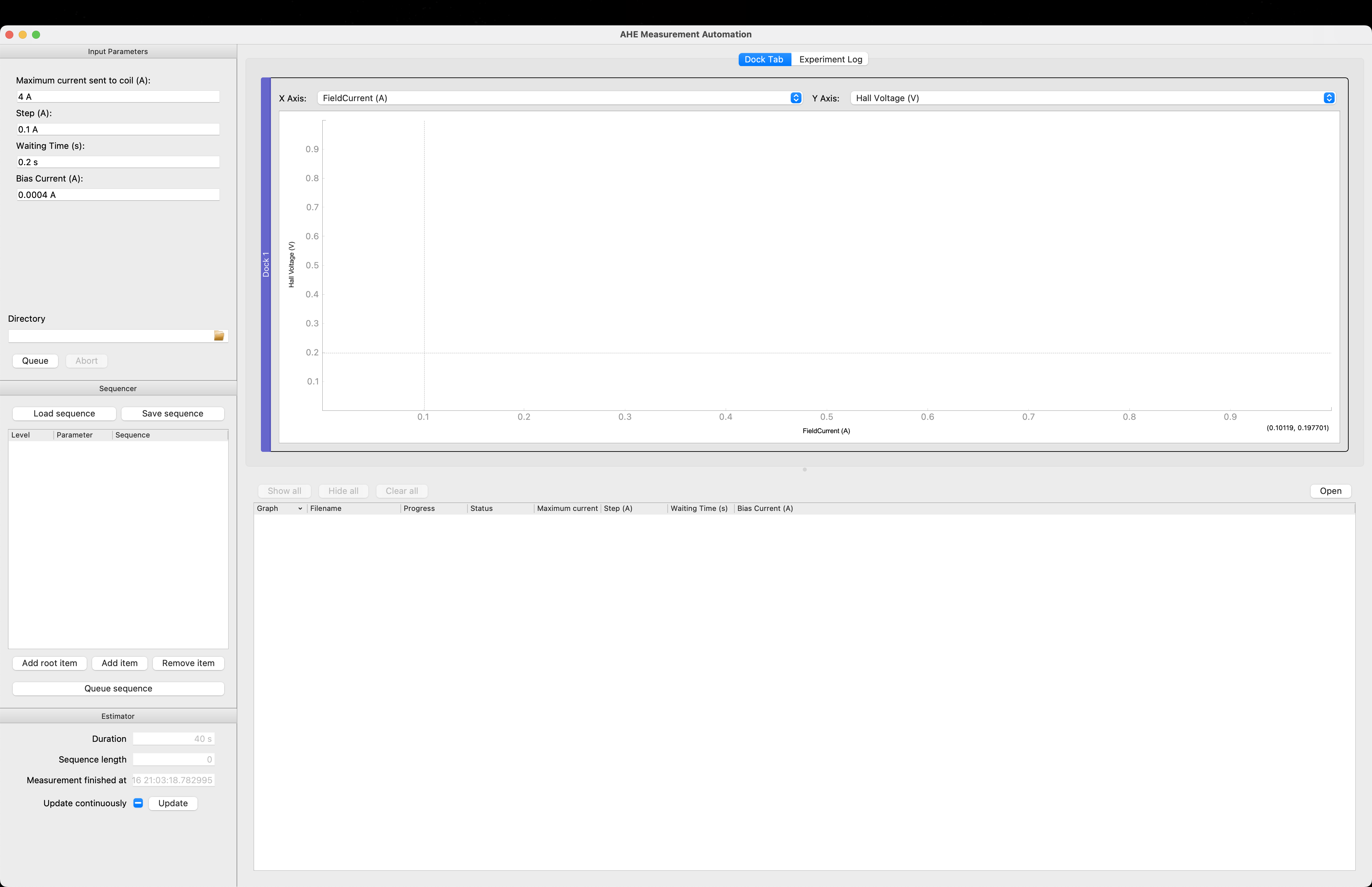
The Soure Measure Unit (SMU) to apply one bias-current, and meanwhile measuring the Hall Voltage. Hysteresis loops can be obtained by looping the electromagnetic field.
The software has following features:
AutoVA_1.0.0
Compatible with a large amount of SMUs, and instruments
Experiments procudures visualised
GUI for graphing live data
managing queues of experiments.
Data auto-generation
AutoVA_1.0.1
The automated experiment time can be estimated and updated in real time.
AutoVA_1.0.2
The progressbar for single meaurement will be shown
An I-V curve measurement is performed by applying a series of voltages to the device. At each voltage, the current flowing through the device is measured. The supplied voltage is measured by a voltmeter connected in parallel to the device, and the current is measured by an ammeter connected in series. This voltmeter and ammeter can now be integrated to SMU: Source Measure unit, which has been used in this project.
Superpowers is a complete software development methodology for your coding agents, built on top of a set of composable skills and some initial instructions that make sure your agent uses them.
It starts from the moment you fire up your coding agent. As soon as it sees that you’re building something, it doesn’t just jump into trying to write code. Instead, it steps back and asks you what you’re really trying to do.
Once it’s teased a spec out of the conversation, it shows it to you in chunks short enough to actually read and digest.
After you’ve signed off on the design, your agent puts together an implementation plan that’s clear enough for an enthusiastic junior engineer with poor taste, no judgement, no project context, and an aversion to testing to follow. It emphasizes true red/green TDD, YAGNI (You Aren’t Gonna Need It), and DRY.
Next up, once you say “go”, it launches a subagent-driven-development process, having agents work through each engineering task, inspecting and reviewing their work, and continuing forward. It’s not uncommon for your agent to work autonomously for a couple hours at a time without deviating from the plan you put together.
There’s a bunch more to it, but that’s the core of the system. And because the skills trigger automatically, you don’t need to do anything special. Your coding agent just has Superpowers.
Commercial Services
If you’re using Superpowers in enterprise and could benefit from commercial support, additional tooling, or managed spending, please don’t hesitate to drop us a line at sales@primeradiant.com.
Installation
Installation differs by harness. If you use more than one, install Superpowers separately for each one.
Install Superpowers as a Pi package from this repository:
1
pi install git:github.com/obra/superpowers
For local development, run Pi with this checkout loaded as a temporary package:
1
pi -e /path/to/superpowers
The Pi package loads the Superpowers skills and a small extension that injects the using-superpowers bootstrap at session startup and again after compaction. Pi has native skills, so no compatibility Skill tool is required. Subagent and task-list tools remain optional Pi companion packages.
The Basic Workflow
brainstorming - Activates before writing code. Refines rough ideas through questions, explores alternatives, presents design in sections for validation. Saves design document.
using-git-worktrees - Activates after design approval. Creates isolated workspace on new branch, runs project setup, verifies clean test baseline.
writing-plans - Activates with approved design. Breaks work into bite-sized tasks (2-5 minutes each). Every task has exact file paths, complete code, verification steps.
subagent-driven-development or executing-plans - Activates with plan. Dispatches fresh subagent per task with two-stage review (spec compliance, then code quality), or executes in batches with human checkpoints.
test-driven-development - Activates during implementation. Enforces RED-GREEN-REFACTOR: write failing test, watch it fail, write minimal code, watch it pass, commit. Deletes code written before tests.
requesting-code-review - Activates between tasks. Reviews against plan, reports issues by severity. Critical issues block progress.
finishing-a-development-branch - Activates when tasks complete. Verifies tests, presents options (merge/PR/keep/discard), cleans up worktree.
The agent checks for relevant skills before any task. Mandatory workflows, not suggestions.
The general contribution process for Superpowers is below. Keep in mind that we don’t generally accept contributions of new skills and that any updates to skills must work across all of the coding agents we support.
Fork the repository
Switch to the ‘dev’ branch
Create a branch for your work
Follow the writing-skills skill for creating and testing new and modified skills
Submit a PR, being sure to fill in the pull request template.
Skill-behavior tests use the drill eval harness from superpowers-evals, cloned into evals/ — see evals/README.md for setup. Plugin-infrastructure tests live at tests/ and run via the relevant run-*.sh or npm test.
See skills/writing-skills/SKILL.md for the complete guide.
Updating
Superpowers updates are somewhat coding-agent dependent, but are often automatic.
License
MIT License - see LICENSE file for details
Visual companion telemetry
Because skills and plugins don’t provide any feedback to creators, we have no idea how many of you are using Superpowers. By default, the Prime Radiant logo on brainstorming’s optional visual companion feature is loaded from our website. It includes the version of Superpowers in use. It does not include any details about your project, prompt, or coding agent. We don’t see your clicks or anything about what you’re building. This helps us have a rough idea of how many folks are using Superpowers and which version of Superpowers they’re using. It’s 100% optional. To disable this, set the environment variable SUPERPOWERS_DISABLE_TELEMETRY to any true value. Superpowers also honors Claude Code’s DISABLE_TELEMETRY and CLAUDE_CODE_DISABLE_NONESSENTIAL_TRAFFIC opt-outs.
This post is now complemented by the generated Agent Skills catalogue, which is updated by the Telegram skill-index automation. The rest of this post remains a snapshot/reference for the broader skills repository collection.
This post is based on the Github repository Skill-Repository maintained by Bryce Wang, a PhD student at Stanford University. The repository is a collection of skills for agents, which are useful for empirical research in the field of artificial intelligence. The repository is regularly updated with new skills and resources, making it a valuable resource for researchers and practitioners in the field. The skills in the repository cover a wide range of topics, including natural language processing, computer vision, reinforcement learning, and more. Each skill is accompanied by a description, code examples, and links to relevant papers and resources. The repository is organized into different categories, making it easy to navigate and find specific skills. Overall, the Skill-Repository is a comprehensive and valuable resource for anyone interested in learning about agent skills and their applications in empirical research.
The awesome collection of Claude Code subagents.
More awesome collections for developers
Awesome Claude Code Subagents
This repository serves as the definitive collection of Claude Code subagents, specialized AI assitants designed for specific development tasks.
Installation
As Claude Code Plugin (Recommended)
1
2
claude plugin marketplace add VoltAgent/awesome-claude-code-subagents
claude plugin install <plugin-name>
Examples:
1
2
claude plugin install voltagent-lang    # Language specialists
claude plugin install voltagent-infra   # Infrastructure & DevOps
Subagents are specialized AI assistants that enhance Claude Code’s capabilities by providing task-specific expertise. They act as dedicated helpers that Claude Code can call upon when encountering particular types of work.
What Makes Subagents Special?
Independent Context Windows Every subagent operates within its own isolated context space, preventing cross-contamination between different tasks and maintaining clarity in the primary conversation thread.
Domain-Specific Intelligence Subagents come equipped with carefully crafted instructions tailored to their area of expertise, resulting in superior performance on specialized tasks.
Shared Across Projects After creating a subagent, you can utilize it throughout various projects and distribute it among team members to ensure consistent development practices.
Granular Tool Permissions You can configure each subagent with specific tool access rights, enabling fine-grained control over which capabilities are available for different task types.
Core Advantages
Memory Efficiency: Isolated contexts prevent the main conversation from becoming cluttered with task-specific details
Enhanced Accuracy: Specialized prompts and configurations lead to better results in specific domains
Workflow Consistency: Team-wide subagent sharing ensures uniform approaches to common tasks
Security Control: Tool access can be restricted based on subagent type and purpose
Getting Started with Subagents
1. Access the Subagent Manager
1
/agents
2. Create Your Subagent
Choose between project-specific or global subagents
Let Claude generate an initial version, then refine it to your needs
Provide detailed descriptions of the subagent’s purpose and activation triggers
Configure tool access (leave empty to inherit all available tools)
Customize the system prompt using the built-in editor (press e)
3. Deploy and Utilize Your subagent becomes immediately available. Claude Code will automatically engage it when suitable, or you can explicitly request its help:
1
> Have the code-reviewer subagent analyze my latest commits
Subagent Storage Locations
Type
Path
Availability
Precedence
Project Subagents
.claude/agents/
Current project only
Higher
Global Subagents
~/.claude/agents/
All projects
Lower
Note: When naming conflicts occur, project-specific subagents override global ones.
You can override any agent’s model by editing the model field in its frontmatter. Set model: inherit to use whatever model your main conversation is using.
Tool Assignment Philosophy
Each subagent’s tools field specifies Claude Code built-in tools, optimized for their role:
This repository is a curated collection of subagent definitions contributed by both the maintainers and the community. All subagents are provided “as is” without warranty. We do not audit or guarantee the security or correctness of any subagent. Review before use, the maintainers accept no liability for any issues arising from their use.
If you find an issue with a listed subagent or want your contribution removed, please open an issue and we’ll address it promptly.
A curated, opinionated list of 119 GitHub repositories and 23,000+ AI Agent Skills for empirical research in economics, political science, sociology, psychology, public health, education, management, finance, and public policy — organized by research workflow, from topic selection to journal submission.
2026 年,实证研究的工作方式正在被重新定义。
CoPaper.AI —— 由 Stanford REAP(中国经济与制度研究中心)研究者团队孵化的实证研究 AI 助手——已经做到 20 分钟完成一篇主流期刊级别的实证论文:从数据导入、描述性统计、因果推断模型、稳健性检验到结果表格,一步到位。这背后的秘密不是更强的模型,而是 Skills:把资深研究者的方法论经验编码成结构化工作流,让 AI 知道”一个完整的 DID 分析应该包含哪些步骤”,而不是每次都等你一步步提醒。
As electronic devices continue to shrink to just a few nanometers, enabling the integration of billions of devices in computers, power consumption has surged beyond control, exceeding thermal limits and leading to failure. To address this issue, researchers are exploring an alternative to conventional electronics by harnessing the property of “spin” rather than “charge.” This emerging field, known as spintronics, compared to its counterpart electronics, holds the promise of more energy-efficient quantum computing and data storage, and beyond. Recent successes with van der Waals (vdW)–layered diluted magnetic chalcogenide semiconductors (dMCSs) are promising and have sparked a vibrant research community. This field is still in its infancy on the path to realizing the ultimate spintronics. But it is highly likely that the remaining scientific challenges can be overcome within the next decade or so.